

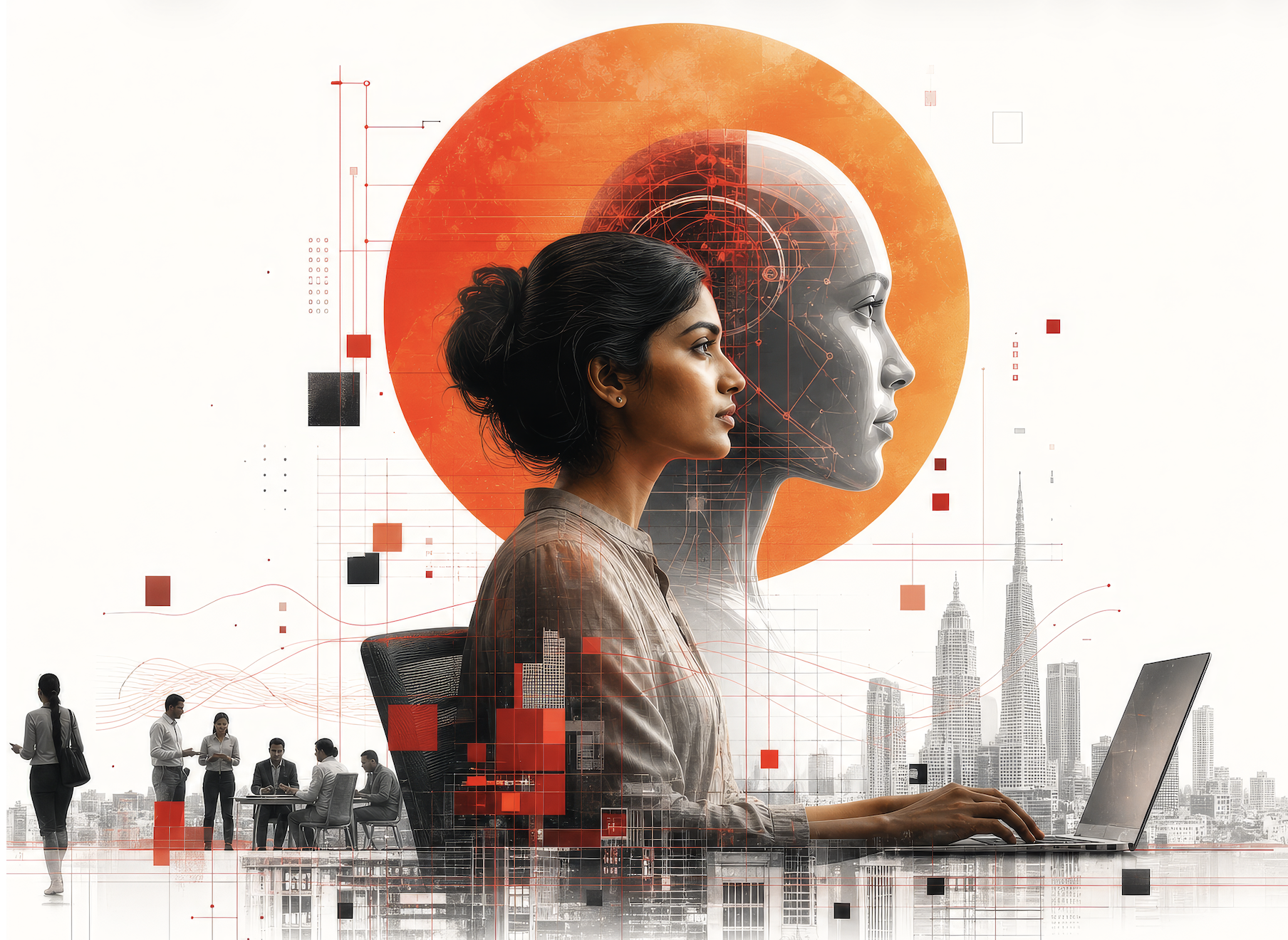
For years, artificial intelligence felt distant to most employees. Something discussed at tech conferences. Or demonstrated dramatically in futuristic presentations filled with glowing graphics and phrases like “disruption at scale.”
Now it quietly sits inside everyday work. Writing emails. Summarizing meetings. Screening résumés. Generating code. Building presentations. Analyzing customer data.
Suggesting replies before people have fully decided what they actually want to say.
And perhaps the strangest part is how quickly people adapted. A technology once treated like science fiction has become something employees casually use between spreadsheets and coffee breaks. Which is why the future of AI at work may not look dramatic at all. Not robots replacing entire offices overnight. Not humans disappearing from the workplace.
But something subtler.
AI becoming the silent co-pilot of modern work.
Always present. Quietly influencing decisions, workflows, communication, hiring, productivity, and creativity in ways people may not even fully notice anymore.
India Is Entering a Massive Workplace Transition
India is uniquely positioned in this transformation. The country has one of the world’s largest digital workforces, a rapidly growing startup ecosystem, expanding internet access, and aggressive adoption of AI across sectors such as IT, customer service, healthcare, fintech, education, retail, logistics, and manufacturing.
Organizations are already integrating AI tools into daily operations. Sometimes strategically. Sometimes chaotically. Often both. The result is not simply automation. It is a gradual redesign of work itself. Routine tasks are increasingly being delegated to machines. Which means human roles are shifting toward judgment, creativity, relationship-building, contextual thinking, and decision-making.
At least in theory.
Because in reality, workplaces are still figuring this out in real time.
The Most Important Jobs May Not Disappear – They May Change
Much of the public conversation around AI swings between two extremes.
Panic.
Or blind optimism.
Either AI will replace everyone. Or it will magically create unlimited opportunity. The truth is probably less cinematic. Most jobs will not disappear instantly. But many jobs will evolve significantly. Employees may spend less time doing repetitive administrative work and more time managing systems, validating outputs, solving complex problems, and interpreting information.
The accountant still exists. But now works alongside AI-assisted analytics.
The recruiter still exists. But increasingly evaluates candidates screened by algorithms.
The designer still exists. But collaborates with generative AI tools.
The customer service executive still exists. But handles escalations while chatbots resolve routine requests.
The shift is less about replacement. More about redistribution.
Machines handling predictable tasks. Humans handling ambiguity.
The Skill Shift Has Already Started
This transition is creating enormous pressure on India’s workforce. Because AI changes the value of skills. Technical literacy matters more. Adaptability matters more. Communication matters more. Critical thinking matters more. And ironically, deeply human skills are becoming even more important precisely because machines are becoming more capable.
Organizations increasingly want employees who can collaborate with AI instead of competing against it. People who know how to ask better questions. Interpret outputs. Detect errors. Exercise judgment. And make ethical decisions.
Which may explain why companies are simultaneously investing in AI upskilling and soft-skill development.
Because knowing how to use AI tools is one thing. Knowing when not to trust them is another.
India’s Opportunity — And Risk
AI could become one of India’s biggest economic opportunities. The country already plays a major role in global technology services. If India successfully scales AI adoption, skilling, infrastructure, and innovation, it could reshape entire sectors while creating new categories of employment.
But the transition also carries risks. Access inequality. Skill gaps. Digital exclusion. Algorithmic bias. Job displacement in repetitive functions. And a widening divide between workers who can adapt quickly and those left behind. This is particularly important in a country where millions are still entering the formal workforce for the first time.
AI may increase productivity. But unless managed carefully, it may also deepen existing inequalities.
The Psychological Shift Nobody Discusses Enough
Perhaps the biggest workplace change will not be technological. It will be emotional. Employees are entering an era where work itself feels less stable. People are increasingly unsure which skills will remain valuable. Which industries will transform fastest. Which tasks will become automated. And how quickly expectations will change.
That uncertainty creates anxiety. But also constant pressure to remain relevant. Modern professionals are no longer simply doing their jobs. They are continuously trying to future-proof themselves.
Learning new tools. Updating skills. Reinventing roles. Monitoring trends.
Trying not to fall behind. Which is exhausting in ways organizations often underestimate.
The Real Question Is Not Human vs AI
The most useful conversations about AI are slowly moving away from the idea of competition. Because the future of work is unlikely to be humans versus machines. It will be humans working through machines. The real differentiator may not be who has access to AI. Eventually, everyone will.
The differentiator may become who knows how to combine technology with judgment, empathy, creativity, ethics, and contextual understanding. The qualities machines still struggle to replicate convincingly.
At least for now.
Final Reflection
There is something fascinating about this moment in history. Human beings spent decades building machines capable of thinking more like humans. And now humans are quietly reorganizing their own behavior around machines.
The office is changing.
Careers are changing.
Learning is changing.
Attention itself is changing.
And perhaps the defining feature of the next decade will not be dramatic technological domination.
But millions of ordinary people slowly learning how to work alongside invisible systems that increasingly shape modern life.
Not loudly.
Not suddenly.
But quietly.
Like a co-pilot sitting beside us the entire time.