

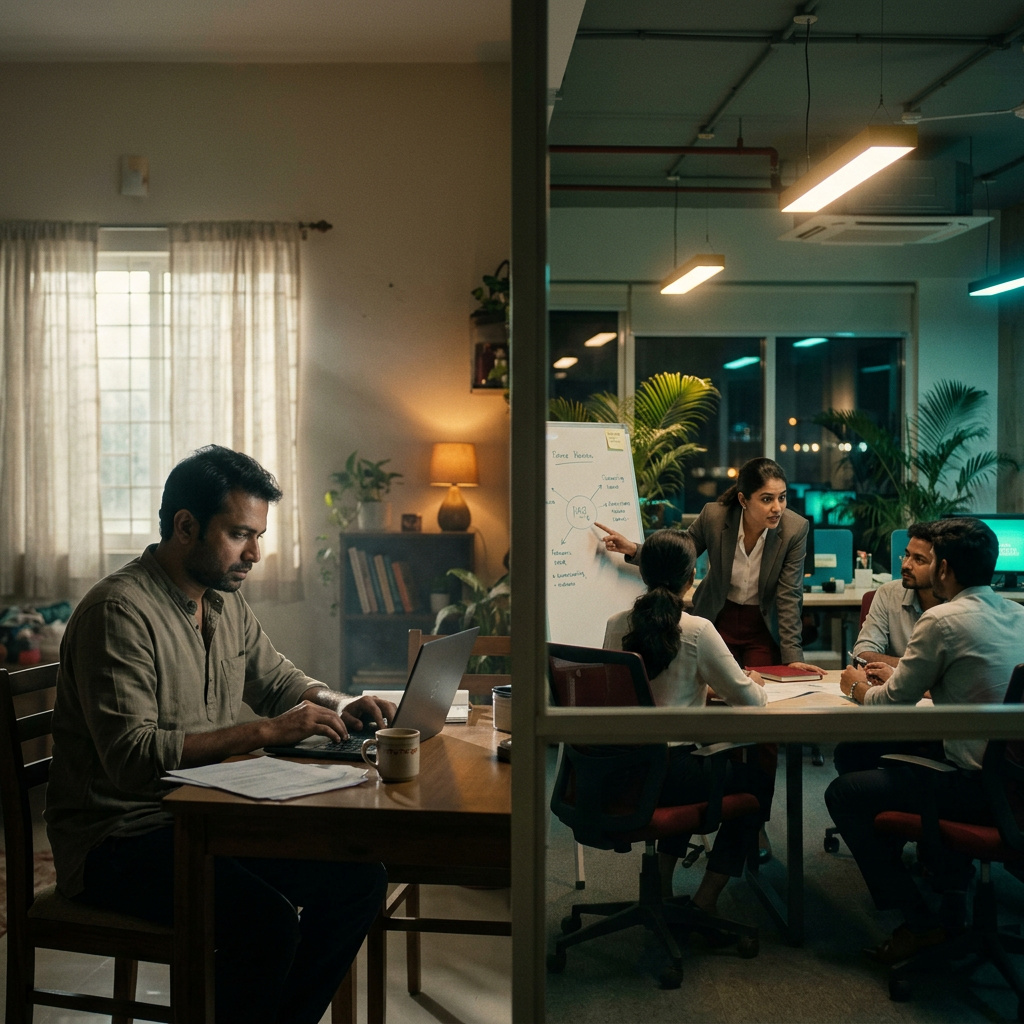
For a brief moment after the pandemic, it felt like office culture might quietly disappear.
People discovered they could work from bedrooms, kitchen tables, cafés, hometowns, and occasionally from places where the Wi-Fi signal depended entirely on standing near a specific window. Commutes vanished. Formal shoes disappeared. And millions of employees experienced something revolutionary. Lunch at home.
Then reality complicated the fantasy.
Because while remote work solved certain problems beautifully, it also created new ones nobody fully anticipated. Isolation. Blurred boundaries. Meeting fatigue. Loneliness. Endless notifications. Workdays that quietly stretched from morning into midnight because the office never technically closed anymore.
Now India’s workplaces are caught in the middle of an awkward balancing act. Employees want flexibility. Companies want collaboration. And everyone is still pretending this transition is more organized than it actually is.
The Great Return-To-Office Tug of War
Across India, organizations are steadily pushing employees back toward physical workplaces. Some companies require three in-office days. Others mandate full attendance. Many are redesigning hybrid structures that somehow attempt to satisfy leadership expectations, productivity goals, and employee well-being simultaneously. Which sounds reasonable in theory.
Until you realize most people are still emotionally negotiating what work is even supposed to look like anymore. Employees argue that flexibility improved quality of life. No commute. More family time. Lower exhaustion. Greater autonomy. Managers argue that collaboration, mentorship, creativity, and culture weaken when teams become permanently remote.
And honestly? Both sides are right. That is what makes this conversation so complicated.
The Office Was Never Just About Work
One thing the remote-work debate exposed very clearly is that offices were never only about productivity. They were social systems. Places where people absorbed culture indirectly. Where careers advanced through visibility as much as performance. Where juniors learned simply by observing seniors. Where friendships formed accidentally near coffee machines. Where entire teams bonded through shared irritation toward air-conditioning temperatures.
Remote work replicated tasks. But not always connection.
Because collaboration is rarely just the scheduled meeting. It is the five-minute conversation after the meeting. The random idea. The casual clarification. The body language. The energy in the room.
And many organizations are now realizing those invisible interactions mattered more than they initially thought.
But Employees Have Changed Too
The problem is, employees are not willing to return to the old system unquestioningly. Especially younger professionals. Gen Z entered the workforce during one of the largest workplace experiments in modern history. For them, flexibility is not a privilege. It feels normal. Expected. Part of what defines a good employer.
Many employees now openly ask about hybrid policies during interviews. Some reject roles entirely if flexibility is missing. And perhaps the biggest shift of all is psychological. People no longer automatically believe work deserves unlimited access to their lives.
That mindset changed permanently. Which explains why return-to-office mandates often trigger emotional resistance far beyond simple commuting inconvenience.
For many employees, it feels symbolic. Like losing control again.
The Burnout Nobody Expected
Ironically, remote work also exposed how unhealthy many work cultures already were. Employees working from home often ended up working longer. Not shorter. Without physical separation between office and personal life, work began leaking into evenings, weekends, and vacations.
Some organizations in India have started introducing policies aimed at controlling excessive working hours, monitoring burnout risks, and encouraging structured hybrid schedules. Because flexibility without boundaries quickly turns into permanent availability. And permanent availability eventually becomes exhaustion.
The pandemic did not magically create work-life balance. It simply moved workplace stress into people’s homes.
The Office Itself Is Changing
Perhaps the clearest sign that hybrid work is here to stay is what is happening to office spaces themselves. Companies are redesigning workplaces around flexibility. Collaborative zones. Smaller assigned seating. Co-working environments. Hot desks. Meeting hubs. Spaces optimized less for attendance… and more for interaction. Because organizations increasingly understand something important.
If employees are going to commute again, the office needs to offer something beyond rows of laptops and fluorescent lighting.
People are no longer asking:
“Can this work be done remotely?”
They already know it can.
Now they are asking:
“Why should I come in at all?”
That is a much harder question.
The Future Is Probably Neither Extreme
The loudest voices in the remote-work debate often speak in absolutes. Remote forever. Office forever. But most workplaces are slowly drifting toward something messier and more realistic. Hybrid. Not because it is perfect. But because it acknowledges a truth modern organizations are struggling to accept.
People want flexibility. But they also want connection. They want autonomy. But not isolation. They want freedom. But also belonging.
And companies are trying to design systems around those contradictions in real time.
Final Reflection
Maybe the office is not really making a comeback. Maybe it is being forced to justify its existence for the first time. And honestly, that may not be a bad thing. For decades, people came to offices because they had no choice. Now workplaces must offer something meaningful enough to make people want to return.
Not just physically. But emotionally.
That changes everything.