


Over the last few years, Indian organisations have faced disruptions that no business continuity plan could have fully anticipated. Economic volatility, rapid technological change, shifting workforce expectations, supply chain challenges, and evolving customer demands have become the new normal. Add the interim knee-jerk reaction of the current geopolitical situations.
Some organisations are struggling to keep pace, others are adapting, recovering and scaling.
So, is it a difference in size, industry, or how business transactions are carried out for profitability?
In my experience, it’s always workforce resilience. And this is not built during a crisis. It is built long before one arrives. It is reflected in how organisations develop interpersonal communication, empower leaders, build capabilities, make decisions, embrace technology, and create cultures where people are willing and able to adapt. Too often, businesses invest heavily in growth strategies, systems, and infrastructure while underinvesting in organisational capability. Yet it is capability that ultimately determines whether a business can sustain performance through uncertainty.
Over the years, I have found that resilient organisations consistently strengthen six interconnected capabilities. I refer to this as the Resilience Wheel Framework.
Figure 1: The Resilience Wheel – Organisational resilience is created when leadership, culture, skills, technology, agility and employee wellbeing operate as a connected system rather than isolated initiatives. (The diagram below was redesigned by AI; however, operates on the scale of the 6 cogs mentioned within)
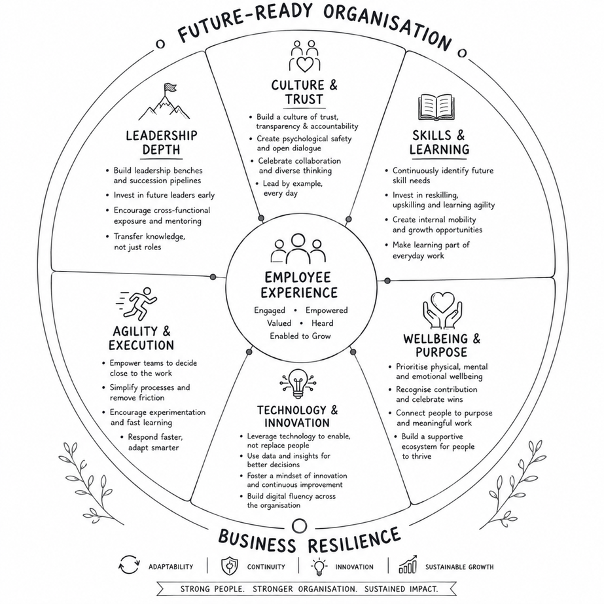
Each component strengthens the others. A company’s investment in cutting-edge technology is enhanced by its use by skilled employees and agile decision-making. Strong leaders are empowered with teams that collaborate and innovate with the same accountability. Future-ready organisations intentionally build all six capabilities.
1. Leadership Depth Over Leadership Dependency
The Future gets risky when orgs unknowingly become dependent on a handful of key individuals for decisions, expertise, customer relationships, and institutional knowledge. Resilient organisations build benches instead of bottlenecks. They identify successors early, expose talent to cross-functional experiences, and create opportunities for emerging leaders to make and effect decisions before they formally step into larger roles. The true test of resilience is not having a strong CEO. It is having a bench of strong leaders who can become CEO.
2. Building Cultures That Can Absorb Change
It’s easy to claim agility but look deeper and very few cultures genuinely support it from the ground up. In periods of uncertainty, culture shines through. Teams either collaborate or retreat into silos. Managers can empower people or create decision paralysis. Organisations with high levels of trust adapt faster because employees are comfortable sharing ideas, challenging assumptions, and solving problems together.
Transparency, accountability, and psychological safety are no longer “nice-to-have” cultural concepts. They are business capabilities.
3. Investing in Skills Before They Become Critical
The shelf life of skills is shrinking rapidly. Future-ready organisations do not wait for capability gaps to appear before acting. They continuously invest in reskilling, upskilling, and creating internal mobility opportunities.
For example, organisations introducing AI tools often focus on technology deployment. The more successful workforce strategy is that which simultaneously equips managers and employees with the skills needed to work differently (what we popularly call soft skills, think -mind-mapping, adaptability, problem solving, conflict mgmt. and performance). Technology changes quickly. Learning agility is what creates long-term advantage.
4. Balancing Technology with Human Capability
Artificial Intelligence, automation, and analytics are reshaping how work gets done. However, technology does not = resilience or protection from volatility. The most successful transformations occur when organisations focus equally on people adoption and technological implementation. Systems can automate workflows. It cannot replace judgment, empathy, critical thinking, relationship-building, or leadership. Future-ready organisations treat technology as an accelerator of human capability rather than a substitute for it.
5. Embedding Agility into Organisational Design
In almost any organisation, opportunities are lost not because people lack capability, but because decision-making and faith move at a different pace. We call it accountability, but it’s mostly a lack of belief that leads to inertia and slows down results. Why? Many older orgs are centered around single-person decision-making, micro bureaucracy, and these safe structures often become barriers during periods of change. Resilient organisations simplify where possible. They empower teams closer to the problem, shorten feedback loops, and encourage cross-functional collaboration. Agility is not about moving faster. It is about removing friction.
6. Prioritizing Wellbeing and Purpose
Perhaps the most underestimated driver of resilience is employee well-being.
Burnout, disengagement, and chronic stress quietly erode productivity, innovation, and decision quality long before they appear on performance reports. Future-ready organisations recognize that sustainable performance requires sustainable people practices. They invest in manager capability, employee experience, recognition, wellbeing, and meaningful work. People are not simply contributors to resilience. They are its foundation.
Balancing the afternoon tea, Peter Drucker famously said, “Culture eats strategy for breakfast.” Walk into any homegrown brand, and they will tell you the same in different words.
Today, I would argue that resilience is the strategy for the long term.
The future will continue to bring uncertainty. New technologies will emerge. Markets will evolve. Workforce expectations will shift.
To really make Indian organisations thrive means to tap into our inherent nature of ‘adapt wherever we are’. Adapting doesn’t mean compromise, rather its optimization until all alternatives are as strong as the ideal.
Resilience is not a contingency plan. It is the mantra we must teach our existing and future workforce. Let’s embrace it for what it is: a leadership responsibility, a cultural imperative, but most importantly, a core business competence.
One Response
Nice article Sonalee, very insightful.
Agree that resilience needs to be up front and centre. And the ability to adapt against changing realities will define success in the near future.