

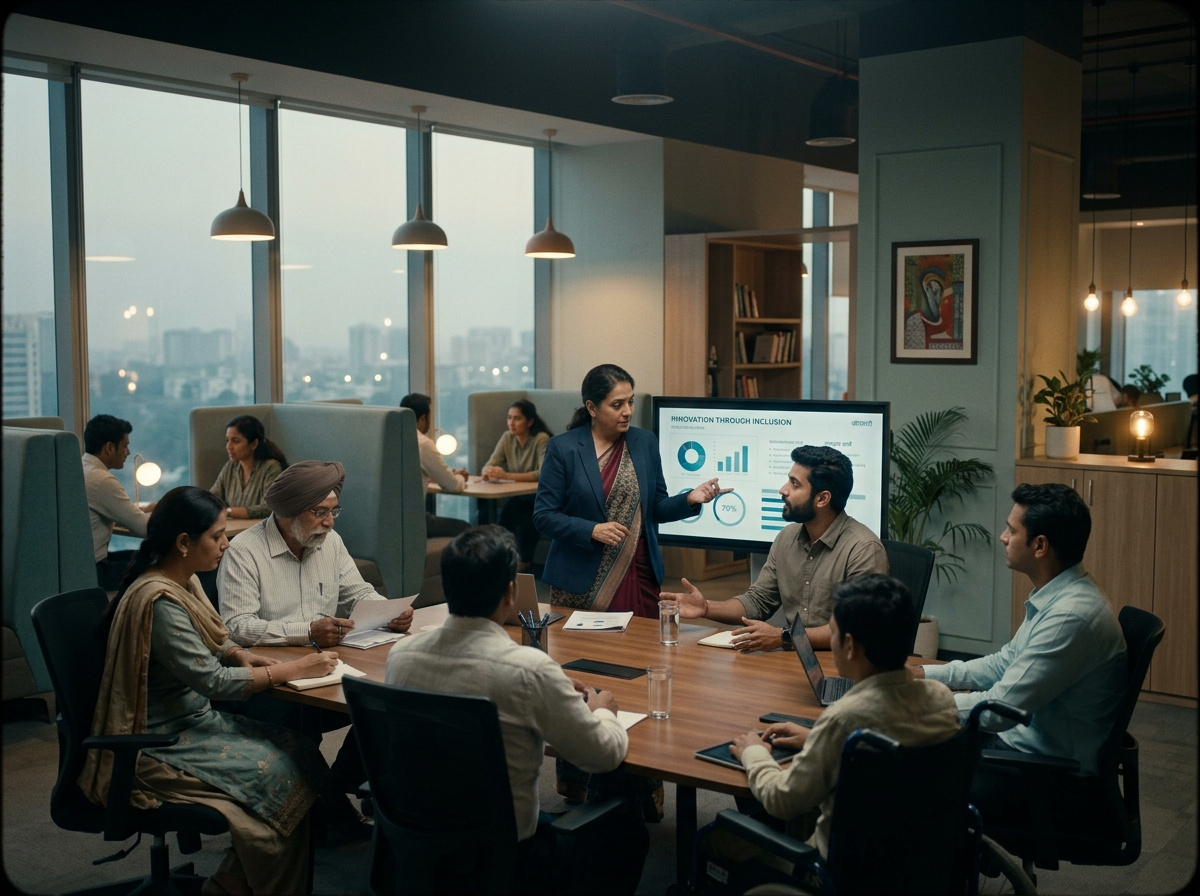
Diversity, Equity, and Inclusion.
Three words that sound universally understood until you actually try applying them in different parts of the world.
Because DEI in India does not operate inside the same social realities as DEI in the West.
The vocabulary may sound similar.
The PowerPoint presentations may even look identical.
But the underlying tensions, histories, and workplace realities are fundamentally different.
In the United States, DEI conversations are often shaped by race, gender identity, immigration, and representation.
In India, the conversation is far more layered.
Caste.
Language.
Region.
Religion.
Economic inequality.
Urban-versus-rural access.
Disability.
Educational privilege.
And sometimes, all of them at once.
Which means Indian organizations attempting to simply import Western DEI templates often discover something very quickly.
Inclusion cannot be copy-pasted.
India’s Diversity Is Deeply Social, Not Just Demographic
India’s complexity is difficult to compress into HR frameworks.
Two employees may technically belong to the same nationality, speak the same language, and work in the same office, yet carry completely different social realities shaped by caste, geography, schooling, class, religion, or economic mobility.
A candidate from metropolitan Mumbai enters the workplace differently from a first-generation graduate from a small town.
A woman from an urban English-speaking background navigates opportunity differently from someone equally talented but excluded by language barriers or limited access.
An employee from the Northeast may still experience stereotyping inside workplaces that proudly describe themselves as globally inclusive.
This is what makes DEI in India uniquely complicated.
The inequalities are often subtle.
Socially inherited.
And quietly normalized.
Which is why inclusion in India cannot stop at representation numbers alone.
It must address access.
Belonging.
Mobility.
And dignity.
The Workplace Contradiction India Is Still Navigating
Indian companies today proudly speak the language of inclusion.
And to be fair, many are making real progress.
Organizations are investing more heavily in women leadership pipelines, disability inclusion, LGBTQIA+ hiring initiatives, flexible workplace policies, mental health programs, and inclusive benefits.
But there is still a gap between policy and everyday behavior.
A company may celebrate diversity week on LinkedIn.
And still have managers who subconsciously prefer hiring people who “sound polished.”
An organization may have inclusive hiring policies.
And still quietly discriminate against accents, surnames, regional identities, or educational backgrounds.
This is not always malicious.
Sometimes it is simply inherited bias operating on autopilot.
The kind people do not even recognize in themselves.
Which makes inclusion harder.
Because the hardest prejudices to confront are the ones disguised as normal behavior.
Why Western DEI Models Don’t Fully Translate
Western DEI frameworks are often built around visible identity markers and formal anti-discrimination systems.
India’s social structure operates differently.
Many forms of exclusion are informal.
Unspoken.
Embedded inside networks, language, educational privilege, and cultural familiarity.
People may never openly discuss caste in a meeting.
Yet it may still influence confidence, opportunity, mentorship, or social belonging.
Regional bias may never appear in official policy.
Yet jokes about accents, food habits, or language continue casually inside workplaces.
Even something as simple as fluency in English can silently function as a gatekeeping mechanism.
Which is why Indian DEI conversations increasingly focus on context-sensitive inclusion rather than imported corporate vocabulary.
Because inclusion in India is not only about who enters the room.
It is also about who feels comfortable speaking once they are inside it.
The Shift From Compliance to Culture
For many years, workplace inclusion in India was largely compliance-driven.
Policies existed because regulations required them.
Now companies are slowly beginning to understand that inclusion affects retention, collaboration, innovation, employer branding, and long-term business sustainability.
Employees increasingly expect workplaces to feel psychologically safe.
Especially younger professionals.
They are asking questions previous generations rarely asked openly.
Can I be myself here?
Will I be judged for my background?
Will leadership actually listen?
Do opportunities flow equally?
Can I disagree safely?
And perhaps most importantly:
Does this organization merely talk about inclusion… or practice it when uncomfortable situations arise?
That last part is where most companies are truly tested.
Because inclusion is easy during campaigns.
It becomes difficult during conflict.
India’s DEI Momentum Is Still Growing
Interestingly, while parts of the Western corporate world are witnessing DEI fatigue, budget cuts, and political pushback, Indian organizations continue expanding many inclusion initiatives.
Partly because India’s workforce itself is too diverse to ignore.
And partly because demographic realities are forcing organizations to widen talent pipelines.
India’s growing digital economy cannot afford to exclude massive segments of capable talent.
Not women returning to work.
Not persons with disabilities.
Not regional talent.
Not underrepresented communities.
Not younger employees demanding healthier workplace cultures.
The business case for inclusion is no longer theoretical.
It is becoming operational.
Final Reflection
There is something revealing about how different societies approach inclusion.
Some countries discuss diversity because history forced them to.
India discusses diversity because daily life constantly reminds it how unequal opportunity can still be.
And maybe that is what makes India’s DEI journey uniquely difficult.
But also uniquely important.
Because in a country this layered, inclusion is not just about fairness.
It is about whether millions of people ever truly feel allowed to participate fully in modern economic life.
That is much bigger than an HR initiative.