
For most of my career, I’ve had a quiet theory about work: that the things hardest to measure are usually the things that matter most.
You can measure headcount, budgets, hiring timelines, completion rates. You cannot measure the way a room feels when a leader walks in. You cannot put a number on whether people say what they actually think, or whether they’ve quietly stopped trying. And yet, over fifteen years of building people functions from the ground up, I’ve learned that this invisible layer is where organizations are truly won or lost.
Now we’ve handed everyone a technology that is brilliant at the measurable, and it’s forcing an uncomfortable conversation about the rest.
The bar for being human at work just went up.
There’s a popular fear that AI will make people redundant. I think the truth is stranger and more demanding: AI is going to make the human parts of our jobs more valuable, not less, and a lot of us are underprepared for that.
When a tool can draft the policy, summarize the survey, screen the first pass of applications, and write a decent first version of almost anything, the work that’s left over is the work that was always the hardest: judgment, context, the courage to make a call when the data is ambiguous, the empathy to notice what a dashboard never will, and the integrity to hold a line when it would be easier not to.
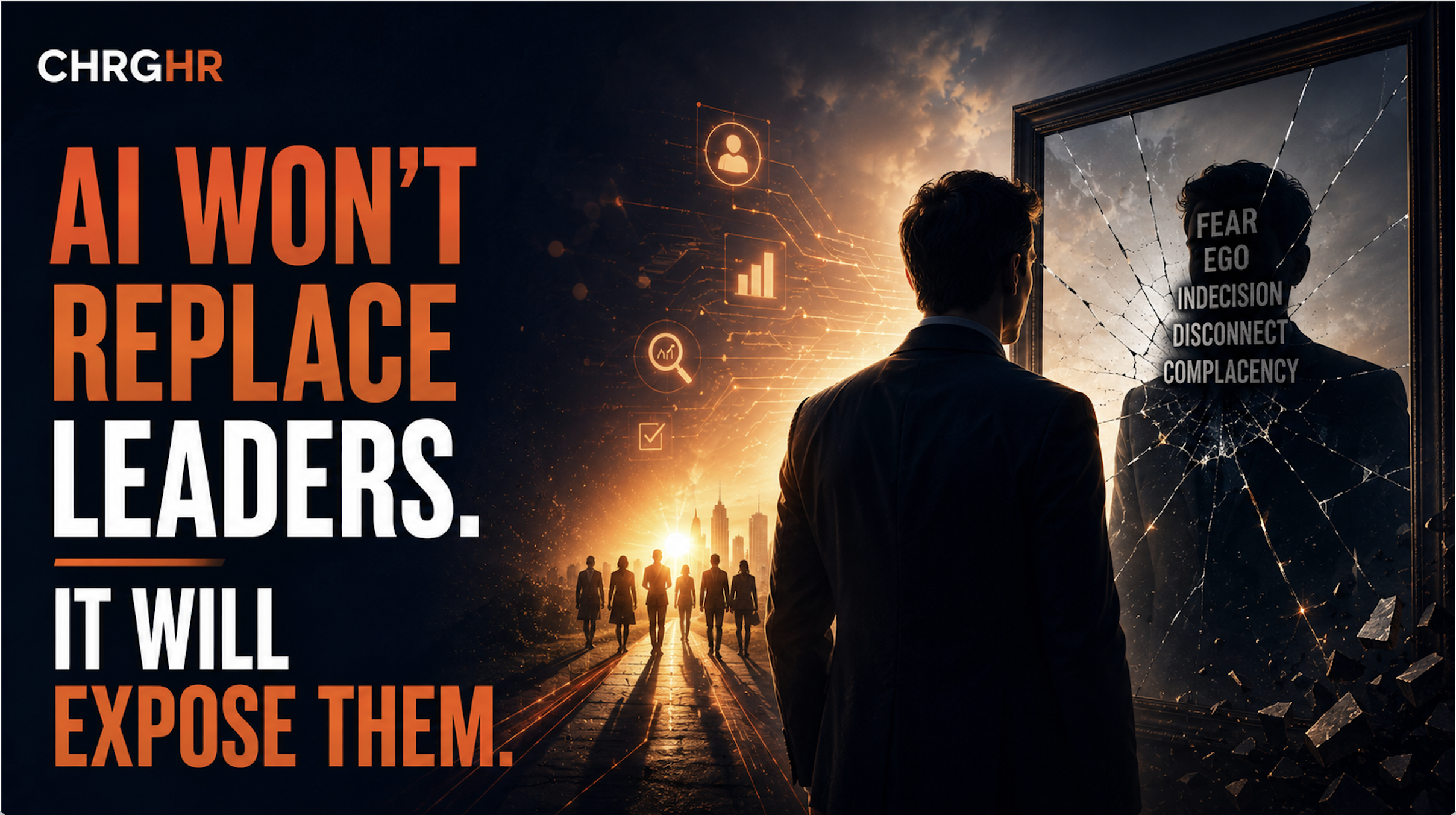
I’ve started to believe that AI doesn’t threaten good leaders. It exposes the gap between the ones who were adding real human judgment and the ones who were mostly moving information around.
Culture is the thing AI can’t fake for you.
I spend a lot of time now experimenting with these tools, not as a spectator, but hands-on, building workflows and breaking them and rebuilding them. And the more I do, the more convinced I am of something counterintuitive:
The more automated our systems become, the more deliberate our culture has to be.
Here’s why. Automation scales whatever you already are. If your organization runs on trust, good tools will help that trust travel faster. If it runs on fear, ambiguity, or unspoken rules, automation will scale those too faster, and with a veneer of objectivity that makes them harder to challenge. An algorithm that inherits a biased process doesn’t remove the bias. It laminates it.
So the question stops being “Which tool should we adopt?” and becomes “What do we actually stand for and are we willing to let a machine make that visible?”
That’s a leadership question. Not a technology one.
Three shifts I keep coming back to
If I had to compress what I’m learning into what I’d tell any leader trying to navigate the next few years, it would be these three things.
- Move from having answers to asking better questions.
For a long time, authority came from knowing more than the people around you. That premium is collapsing information is now abundant and instant. The leaders who’ll matter are the ones who ask the sharper question, frame the real problem, and know which answer to trust. Curiosity is becoming a leadership competency, not a personality trait. - Protect psychological safety like it’s infrastructure because it is.
People will only tell you the truth about a new tool, a broken process, or a failing bet if it’s safe to do so. In a world moving this fast, your early-warning system is the willingness of your people to speak up before something breaks. That safety doesn’t happen by accident. It’s built, defended, and modelled from the top one honest conversation at a time. - Be a builder, not just a buyer.
You don’t need to become an engineer. But you do need to get your hands dirty enough to have an opinion. I’ve found that the fastest way to demystify AI and to lead others through the anxiety it creates is to actually use it, stumble with it, and understand its edges. Leaders who only consume slide decks about the future will always be one step behind the people living in it.
The part that stays the same
Every wave of technology arrives wrapped in the same promise: this time, the work will finally take care of itself. It never quite does. What changes is the level at which humans add value.
Machines are getting extraordinary at answering. Our job as leaders, as colleagues, as people is to get better at the things that were always ours: caring, deciding, trusting, and choosing what kind of place we want to build.
The future of work isn’t a battle between humans and machines. It’s an invitation to be more human, more intentionally, than we’ve ever had to be before.
And honestly I think that’s the most hopeful brief we’ve been handed in a long time.
What’s a human skill you think we’re all going to have to get better at?