
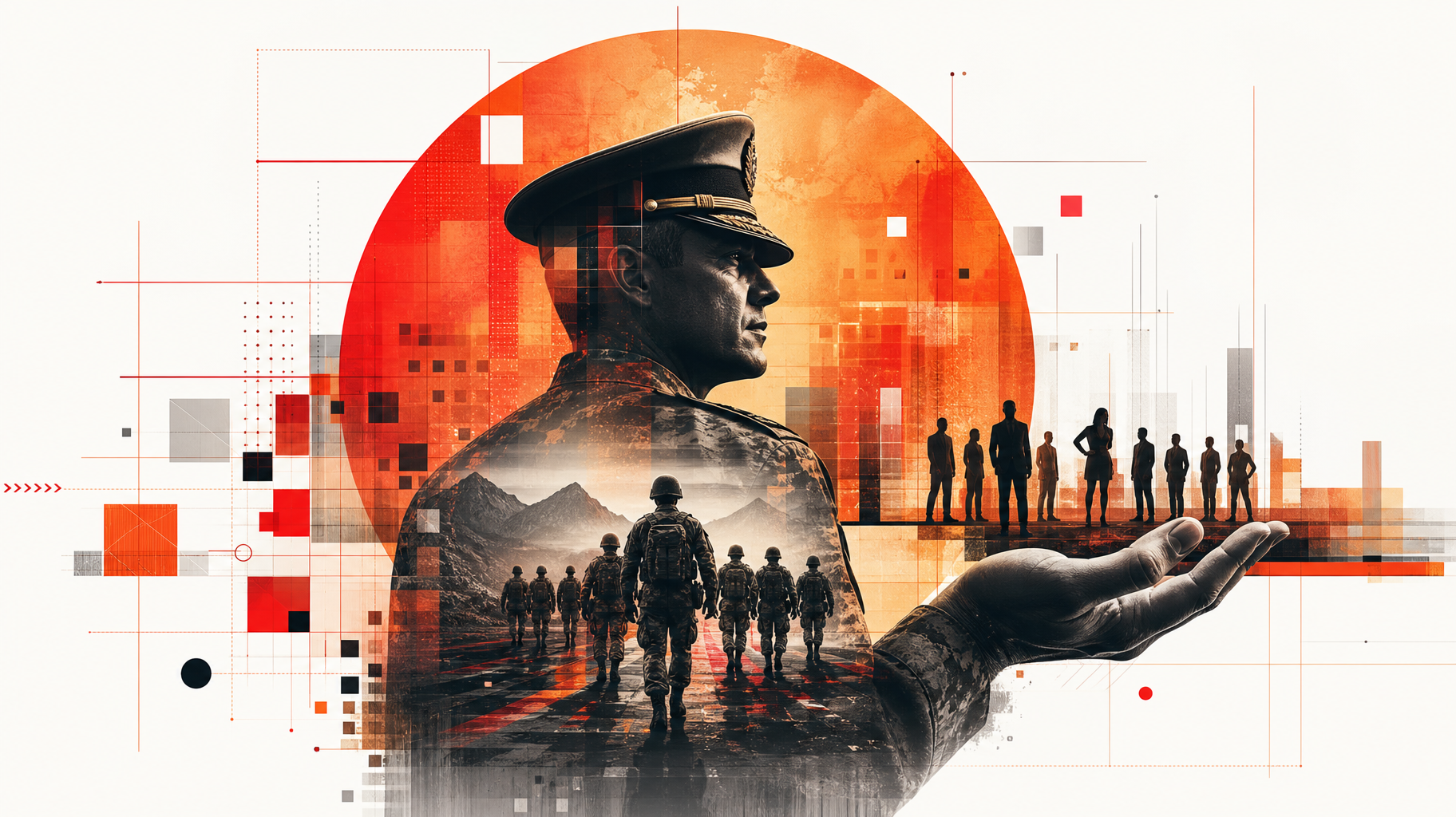
0300 hours. Northern Tip of India. Winter. The kind of cold that gets inside your gear.
I had simultaneous accountability for men, machines, and mission. No consultant on standby. No policy deck to refer to. Just a command, a responsibility, and the people in front of me – every one of them watching to see whether I knew what I was doing.
I did. Twenty years in the Indian Army has a way of making that non-negotiable.
Fast-forward to a boardroom in Mumbai. Founders of a venture-backed AI robotics company on one side of the table. Me on the other, presenting a people strategy that would determine whether this organization could scale internationally or collapse under the weight of its own ambition.
Same room, different uniform. Same fundamentals.
I am writing this not as a career story – I have one of those, and it is available on LinkedIn. I am writing this because I work alongside MDs, CEOs, and founders every single day, and I keep seeing the same expensive mistake: treating HR as a support function rather than a command function. That gap – between HR as administration and HR as organizational leadership – is where companies lose. And it is entirely fixable.
1. MISSION CLARITY IS NOT A VALUES POSTER — IT IS CULTURE ENGINEERING
In the Army, mission clarity is not aspirational. It is operational. Every soldier from the newest jawan to the senior commander knows the objective – what we are doing, why it matters, and what success looks like – because ambiguity in the field costs lives.
When I joined my current organization back in 2022, the energy in the building was extraordinary. The ambition was real. But ask two people in different functions what the company was optimizing for that quarter, and you would get two different answers. That is not a communication problem. That is a culture problem – and culture problems compound.
I applied what the Army calls command intent: a clear articulation of the mission at every layer of the organization, translated for each function’s context. What does the engineering team exist to deliver this quarter? What does the commercial team’s success look like in the context of the company’s larger objectives? When people know the answer to those questions – really know it, not just in an all-hands slide – they make better decisions without being told to.
Culture is not the values printed on a landing page. It is the lived experience of knowing what you are fighting for – and trusting that your leader knows too.
For any MD or founder reading this: if your people strategy and your business strategy are separate documents, you have a structural problem. The people function’s job is to make those two things inseparable.
2. DISCRETION IS A COMPETITIVE ADVANTAGE — NOT A GIVEN
Military command operates under classified conditions. You learn early that information is power, its mishandling has consequences, and there is no room for the kind of institutional gossip that passes as “stakeholder alignment” in certain corporate cultures.
As a CHRO, I sit at the intersection of every sensitive conversation in an organisation. Executive performance concerns. Board-level succession anxieties. Compensation inequities that could fracture leadership teams. M&A negotiations where a single leak changes the outcome. Founder relationships under strain.
These conversations happen with me because founders and boards know – with certainty – that the information goes nowhere it should not. That is not a soft skill. That is a hard-won professional discipline, and it is rarer than it should be at a senior HR level.
The practical implication for any MD evaluating a CHRO: ask yourself whether you would have that person in the room when the most consequential decisions are being made. If the answer is anything other than an immediate yes, the function is not positioned correctly.
3. RESILIENCE IS BUILT IN OPERATIONS – NOT IN OFFSITES
I have deep respect for employee well-being programmes. Mental health matters. Engagement matters. But let me be direct about something: resilience is not built through mindfulness apps. It is built through leadership behavior, consistently demonstrated under pressure.
In the Army, resilience means continuing to execute after your plan has been disrupted. It means retaining composure when the situation deteriorates, making sound decisions under incomplete information, and holding the confidence of your people when the environment is genuinely uncertain. It is not a personality trait. It is an organizational capability – and it is built deliberately or not at all.
When we acquired a Gaming Tech startup in 2023, the integration period was exactly that kind of test. Two distinct organizational cultures. Divergent employment terms. Anxious talent on both sides watching every signal. A business that needed to keep operating at full capacity through the transition.
We retained 95% of the workforce. Not because we deployed an engagement survey. Because we communicated transparently, made specific commitments and honoured every one of them, and projected the kind of visible confidence in the path forward that stops rumor from becoming reality.
That is what military-grade organizational resilience looks like in a corporate integration. It is a deliverable, not a department.
4. EMOTIONAL INTELLIGENCE IS HR STRATEGY — NOT A SOFT SUPPLEMENT TO IT
There is a persistent myth about military leadership: that it is purely command-and-control, authoritarian, and emotionally blunt. In my experience, the finest commanders I served with or under were the most emotionally intelligent leaders I have encountered anywhere – in uniform or boardroom.
Because when the stakes are real, you cannot afford to misread your people. You must know when a team’s morale is eroding before it shows in performance. You must know when a high performer is at capacity versus quietly disengaging. You must be able to communicate difficult truths – restructures, performance concerns, exits — without fracturing the trust that holds organizations together.
In an AI technology company scaling across multiple international jurisdictions, the cost of losing a key technical leader runs into crores of rupees and months of re-hiring. EQ is not a personality layer on top of HR strategy. It is the HR strategy. It is what determines whether your senior leaders stay, whether your culture survives growth, and whether your founder can have the honest conversations the business needs.
This is what I bring to every organization I work with. Not HR as a compliance function. HR as an organizational force multiplier.
THE QUESTION WORTH ASKING
If you are building or scaling an organization today – whether a high-growth startup, a multi-BU industrial group, or a family-owned enterprise preparing for the next chapter – the honest question is this:
Is your people function operating as a process manager – or as a leader who is actively shaping the culture, resilience, and capability of your organization?
The gap between those two answers is the gap between an organization that scales and one that struggles to hold its shape under pressure.
I have worn two uniforms in my career. One was olive green. One is corporate. The rank changed. The responsibility did not. The mission – building organizations that perform, endure, and grow – has remained constant.
5 Responses
Insightful and impactful points.
Couldn’t agree more.
Thanks Bidisha
Great take on the topic. Especially love the call to action to move from a pure operational role to one that drives strategy, culture, capability and resilience
Huge congratulations on this incredible career milestone! 🚀😊
Your transition from the Indian Army to the corporate boardroom is truly inspiring, and it’s wonderful to see how you are seamlessly bridging the two worlds. Bringing that level of battlefield-tested leadership to corporate HR is exactly what modern organizations need.
Love how you’ve focused on building a culture centered around empathy and transparency rather than just standard, on-paper protocols. It takes immense emotional intelligence to move beyond rigid SOPs and focus on real employee well-being and diversity in corporate. Your emphasis on building an inclusive, result-oriented environment while fostering deep resilience within your own team speaks volumes about your leadership.
The HR ecosystem is richer with your vision shaping it. Wishing you continued success in building an impactful, people-first culture!”Best CHRO 👏