

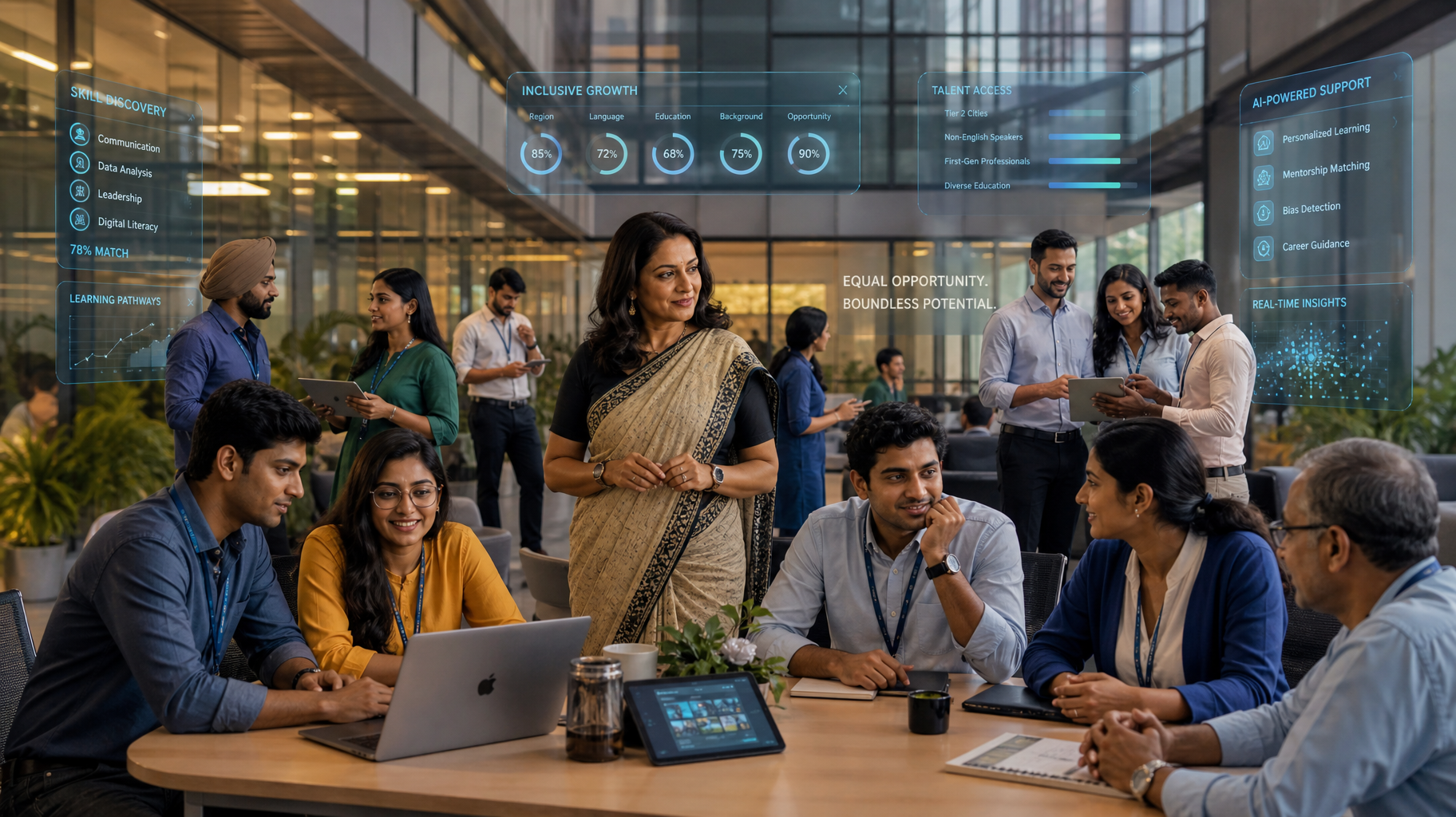
For years, diversity conversations in corporate India largely revolved around one visible metric.
Gender.
How many women were hired? How many made it into leadership? How many panels looked balanced enough for annual reports and LinkedIn campaigns?
And while that progress absolutely matters, India’s workplace realities have always been far more complicated. Because India is not just diverse. It is layered. A country where two people can technically belong to the same organization, speak the same language, and still experience the workplace in completely different ways because of region, class, schooling, accent, caste, or economic background.
Which is why Indian companies are slowly beginning to confront a difficult truth. Inclusion in India cannot stop at gender. Not if it wants to reflect the country honestly.
The Invisible Hierarchies Inside Indian Workplaces
Some workplace inequalities are obvious. Others are so normalized that people barely notice them anymore. An employee from a metro city is often assumed to be more polished. English fluency quietly becomes shorthand for intelligence. Candidates from elite institutions are treated as safer bets. Regional accents become the subject of harmless “jokes.” Employees from smaller towns are expected to “adjust” culturally.
Nobody writes these things into company policy. But they shape workplace behavior every day. That is what makes inclusion in India uniquely difficult. The barriers are often social before they are structural. And inherited long before employees ever enter an office.
Why Companies Are Expanding DEI Beyond Gender
A growing number of organizations are beginning to realize that diversity efforts focused only on gender create an incomplete picture. Because representation alone does not automatically create inclusion. A workplace can have balanced hiring numbers and still make people feel invisible.
This realization is pushing some Indian companies toward broader DEI frameworks. Organizations are increasingly exploring regional inclusion, multilingual communication, disability hiring, socio-economic mobility, returnship programs, and broader access to opportunity. Companies such as Lemon Tree Hotels have received attention for hiring persons with disabilities and candidates from economically disadvantaged backgrounds.
Others are experimenting with multilingual workplace communication, translating policies into regional languages, and building hiring pipelines outside traditional urban talent clusters. These shifts may sound operational. But they are deeply cultural.
Because they challenge long-standing assumptions about what professionalism is supposed to look and sound like.
The Language Problem Nobody Talks About Enough
Language remains one of the biggest invisible filters inside Indian workplaces. India has hundreds of languages and thousands of dialects. Yet corporate success still heavily rewards one communication style.
Urban. English-speaking. Neutral-accented. Globally polished.
Which creates a strange contradiction. A country proud of its diversity often pressures people to sound less like where they come from. Employees constantly code-switch. Changing accents during calls. Simplifying regional identities. Avoiding speaking their native language in professional settings. Trying to appear “corporate enough.”
And perhaps that is why language inclusion matters more than many companies realize. Because language is not just communication. It is identity. Comfort. Confidence. Belonging.
AI: Inclusion Tool or Bias Machine?
Now artificial intelligence is entering this already complicated ecosystem. And like most technologies, AI reflects both the promise and the prejudice of the people building it.
On one hand, AI has enormous potential to improve inclusion in India. rojects such as AI4Bharat and Indian-language AI models are attempting to make digital systems accessible across multiple Indian languages. Translation tools, voice interfaces, multilingual chatbots, and regional language models could dramatically improve access to education, healthcare, banking, governance, and workplace systems.
For a country as linguistically diverse as India, that matters enormously. Technology that understands people in their own language changes participation itself. But AI also introduces a new danger. Bias at scale.
If hiring algorithms are trained primarily on urban, English-speaking, globally standardized data, they may quietly penalize candidates who communicate differently. Different accents. Different sentence structures. Different cultural patterns. Different educational exposure.
The frightening part about algorithmic bias is that it often appears objective. A human interviewer showing bias can at least be questioned. A machine-generated score feels scientific. Neutral. Final. Even when it may simply be automating existing inequalities. That is why researchers and DEI experts increasingly argue that AI governance must become part of inclusion conversations.
Not after systems are deployed. Before.
India’s Real Inclusion Challenge
The hardest part of inclusion is not writing policies. It is changing what people instinctively value. Who sounds competent. Who feels familiar. Who gets mentored. Who gets interrupted. Who gets trusted. Who gets overlooked.
Technology alone will not solve that. And neither will corporate branding campaigns. Because inclusion is ultimately about whether people feel they can participate fully without first erasing parts of themselves.
Final Reflection
India’s diversity has always been both its greatest strength and its greatest social challenge. Now workplaces are beginning to mirror that reality more openly. And perhaps that is progress.
Messy. Uneven. Incomplete. But real.
The question is no longer whether Indian companies should think beyond gender. The question is whether they are prepared to confront the quieter hierarchies hidden inside language, class, region, and opportunity itself. And whether AI will help dismantle those barriers. Or simply make them more efficient.