
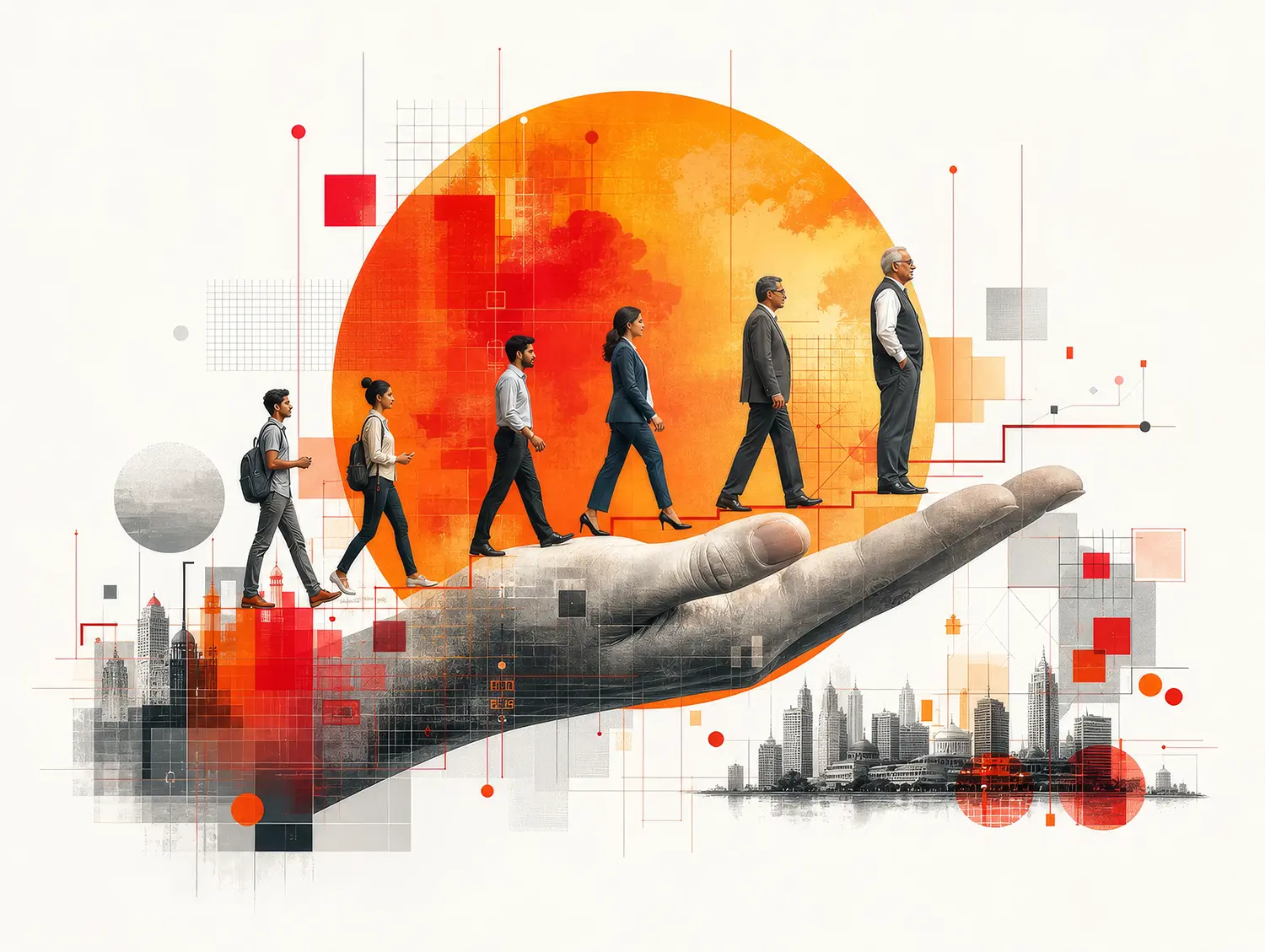
Walk into any large Indian office today and you’ll probably witness three generations reacting very differently to the same meeting.
One person is taking notes in a notebook. Another is turning the discussion into a PowerPoint before the meeting even ends. And someone from Gen Z has already summarized the conversation using AI, created action points, and posted them on Slack before the others have found the “Unmute” button.
That’s the modern Indian workplace. Not divided. Just evolving at different speeds.
India’s workforce is now one of the most generationally diverse in the world. At companies like Infosys, over 50% of employees are under 30, while a significant section of the workforce still belongs to Gen X and Baby Boomers.
And while organizations love using phrases like “multi-generational collaboration,” the reality is often far messier.
Because every generation enters the workplace carrying its own operating system. Different definitions of hard work. Different communication styles. Different expectations from managers. Different relationships with technology. And now, very different comfort levels with AI.
The challenge for HR leaders is no longer just managing talent. It’s managing coexistence.
Communication Isn’t Breaking Down. It’s Fragmenting.
One of the biggest workplace tensions today isn’t workload. It’s interpretation.
A senior manager writes a carefully worded email with bullet points and formal greetings. A younger employee replies with:
“Sure 👍”
Now technically, both people communicated. Emotionally, however, one feels respected. The other feels dismissed.
Boomers and Gen X often associate professionalism with structure, formality, and face-to-face interaction. Younger generations, on the other hand, grew up in the era of instant messaging, voice notes, memes, and asynchronous communication.
To younger employees, quick communication signals efficiency. To older employees, it can sometimes feel abrupt or detached.
And somewhere in the middle sits the millennial manager. Running on caffeine. Translating emotional tone between generations like a workplace diplomat.
The modern office has quietly become a fascinating social experiment. One generation believes cameras should always be on during meetings. Another believes cameras being off is a fundamental human right.
Neither side is wrong. They’re simply products of different professional cultures.
The AI Divide Isn’t About Technology. It’s About Trust.
The assumption that older employees resist technology while younger employees embrace it sounds logical. Reality, however, is more nuanced.
India’s workplaces are currently going through one of the fastest AI adoption shifts in corporate history. Nearly 69% of Indian employees already use AI tools, with almost half relying on them daily.
What’s interesting is not who uses AI. It’s why they use it.
For younger professionals, AI often represents speed. For senior professionals, AI represents relief.
A Gen Z employee may use AI to finish tasks faster. A senior employee may quietly appreciate that technology is finally reducing repetitive manual work.
And despite stereotypes, many older employees are surprisingly optimistic about AI. In fact, studies show that 81% of Boomers believe AI will make work easier.
That statistic surprises people because we love oversimplified narratives. We assume resistance always comes from age. But resistance often comes from uncertainty.
Most employees are not afraid of technology. They’re afraid of becoming irrelevant.
That’s an emotional issue. Not a technical one.
And HR teams that fail to recognize this usually approach AI transformation like a software rollout instead of a human transition.
You can’t simply send employees a webinar link titled:
“Welcome To The Future.”
Especially when half the workforce is privately wondering whether the future still includes them.
Recognition Has Become Deeply Personal
For decades, workplaces rewarded employees in largely predictable ways. Promotions. Bonuses. Certificates. Long-service awards.
But modern employees don’t all value recognition the same way anymore.
Some employees want public appreciation. Others would rather disappear than hear their name announced in a town hall.
Some value flexibility more than money. Others still see stability as the ultimate reward.
This is where many organizations struggle. Because standardization feels operationally convenient. But emotionally, it rarely works.
As HR leaders across organizations are discovering, one-size-fits-all recognition systems increasingly alienate employees instead of motivating them.
A younger employee may value:
- Flexible work
- Learning opportunities
- Wellness support
- Faster career progression
An older employee may prioritize:
- Financial security
- Role clarity
- Healthcare support
- Respect and stability
Neither expectation is unreasonable.
They simply come from different life stages.
The problem begins when organizations confuse equality with sameness.
Treating everyone identically sounds fair in policy documents. But humans don’t experience work identically.
Reverse Mentoring May Be The Most Important Leadership Skill Of The Future
Traditionally, workplaces operated on downward knowledge transfer. Seniors taught juniors. Experience guided youth.
But today’s workplace has created a strange and beautiful reversal.
A 24-year-old employee may understand AI workflows better than a senior leader with 25 years of experience.
Meanwhile, that same young employee may still lack the emotional resilience, political awareness, and decision-making maturity that experience builds over decades.
Which is why reverse mentoring is becoming one of the smartest organizational tools today.
Companies like Infosys and Capgemini have already introduced structured mentorship and cross-generational learning programs to bridge these gaps.
And honestly, some of the best workplaces today aren’t built on hierarchy. They’re built on mutual usefulness.
The younger employee teaches speed. The older employee teaches judgment.
One understands algorithms. The other understands people.
Both matter.
Because contrary to social media mythology, experience hasn’t become obsolete.
It’s just no longer enough by itself.
HR Leaders Are Quietly Becoming Workplace Anthropologists
Modern HR leadership is no longer just about hiring, payroll, or compliance.
It now involves decoding behavior. Understanding generational psychology. Managing emotional expectations. Balancing technological acceleration with human anxiety.
And perhaps most importantly, helping people work together without turning the office into a passive-aggressive group project.
The organizations that succeed won’t necessarily be the ones with the fanciest AI tools. They’ll be the ones that create psychological flexibility.
Because technology evolves quickly. Humans don’t.
People still want respect. Still want purpose. Still want to feel seen. Still want to believe they matter.
That part hasn’t changed across generations. Only the language around it has.
And maybe that’s the real challenge hidden beneath all the workplace conversations about AI, culture, and generational gaps.
Not learning how to work with different generations.
But learning how to understand people whose lives shaped them differently from ours.
Which, when you think about it, has always been the real work anyway.