
Having spent nearly two decades across large corporates, start-ups, family-run businesses and now manufacturing, one thing has remained consistent: formalization is rarely a systems challenge.
It is almost always a people challenge.
Across India, thousands of businesses are currently transitioning from entrepreneurial, relationship-driven ways of working to more structured and scalable operating models. Policies are being introduced. ERP systems are being implemented. Compliance requirements are increasing. Employee management is being digitized. Leadership teams are redesigning structures, roles and responsibilities.
On paper, this sounds straightforward.
On ground, it’s strategic chaos.
You see, the promoter wants visibility. Finance wants controls. HR wants scalable people practices. The newly hired MBA wants dashboards and governance. Younger employees expect modern systems and transparency. Meanwhile, the employee who has spent fifteen years building the business is wondering why conversations are suddenly being replaced by processes.
This is where many organisations get it wrong.
Many organisations mistakenly believe xto10x means replacing relationships with process.
It doesn’t.
The goal isn’t “saare system badal daalo” (to replace entrepreneurial instinct, flexibility or practical judgement)
The goal is to make them scalable; over 100, then 250, then 500 and then 1000s of employees and projects.
Observe the history of workforce transitions. You’ll see that businesses who have made it to the future were the ones that captured experience through systems.
There is a big difference.
We talk about multigeneration workforces as a diversity.
What I see is business vantage. Everyone brings something critical to the table.
How many of you have watched this movie called The Intern starring Robert Deniro? If that rings a bell, what I’m about to share will hit home.
The most experienced employees often carry intelligence that doesn’t exist in any SOP, dashboard or policy document. They know which vendor will deliver during a crisis. They know which machine behaves differently during monsoon season. They know which operational shortcut should never be taken because it creates a quality risk three months later.
The real need is making that knowledge exist out in the open – cause ERPS, AI tools don’t learn instinct.
At the same time, younger professionals bring a very healthy impatience for inefficiency. They question why reports exist in five formats. They challenge manual workarounds. They push for automation. They expect clarity, transparency and speed. Most importantly, they help organisations move from dependency on individuals to information available to all through systems.
Now you see it, don’t you, Balanced Vantage!
One of the biggest lessons I learnt multiple times in my career was this: you scale when experience and innovation stop competing and start collaborating.
In India, the multigenerational conversation is often bigger than age itself. Most organisations are managing multiple realities at once –
The promoter who built the business through singular instincts and long-term relationships.
The experienced operator who knows every customer, vendor and operational workaround.
The MBA hire who wants to dashboard everything, govern all tracking and design new processes.
The Gen Z employee who expects purpose, value and transparency before they have even touched your technology, from day one.
None of them are wrong.
They are simply solving different business problems through different lenses.
For organisations moving from entrepreneurial scale to enterprise scale, encouraging this collaboration closes four critical gaps.
- First, it closes the knowledge gap, that unwritten practical wisdom that needs to be passed on.
- Second, it accelerates digital adoption through cross-mentoring: younger employees champion the tools, and experienced employees provide the practical context for use.
- Third, it builds trust during change. The “changing times and decision table” can be threatening. When you as an organisation visibly value experience on how to navigate change, you open the door for collaboration.
- Fourth, it strengthens succession readiness. Future leaders must understand where the business came from as much as where it is headed. Investments in creating leadership continuity is the only culture policy worth having.
Where exactly does the HR leader step in?
Constantly working with the board and leaders to ensure you don’t treat multigenerational workforce management as an engagement initiative.
Instead use it to solve business problems.
The challenge is rarely ambition.
The challenge is follow-through, and this our role as the Head of Human Resources is
- What do we need, to create enough leadership depth to support growth.
- Where is critical knowledge concentrated?
- Which roles will struggle to scale in their current form? How do we enable something new?
- How do we transfer expertise before it becomes a dependency risk?
We are here to drive the force; our people. For that, we must relentless, tireless warriors in shaping how growth will happen. The people implications must be considered pre and not post.
When we fail, layoffs step in.
The “old school” employees versus the “young crowd.” The “corporate team” versus the “shop-floor team.” The “local fellows” versus the “MBA hires.”
If you want a seat at that “future glorious table”, discard these camps and labels, real people mobility focuses on group outcomes.
Our role as people leaders is to build bridges, not barriers. Personally, this lesson has come full circle.
I was once the young professional who wanted to change every process, automate every activity and move everything faster. I believed faster always meant better. (in some cases, I still do)
Two decades later, I can safely admit that the future of work is built on preserving, documenting, challenging and understanding. Honestly that’s a skillset built over multiple generations.
The Future of work belongs to organisations that can combine competencies and human judgement faster than their competitors.
This is no longer a boardroom agenda.
It is a business growth agenda.
And perhaps one of the most important scaling conversations we need to lead.
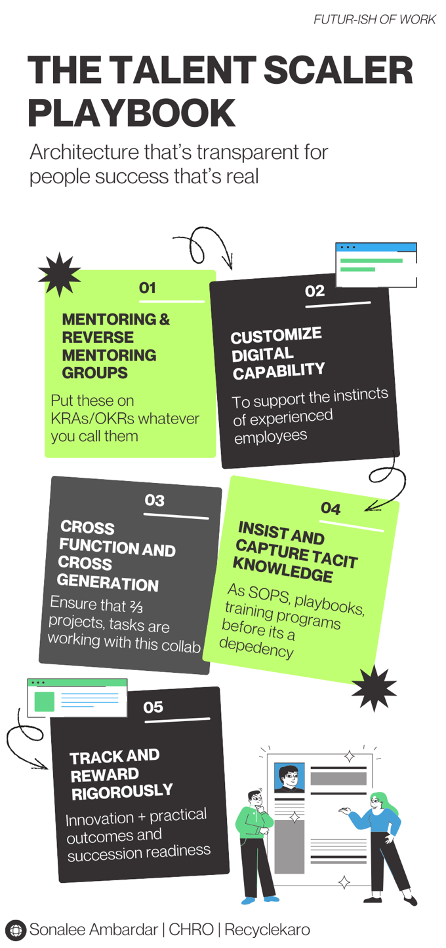
<<< What you see on the right.
With the help of many mentors over my career,
I’ve built a Scaler Playbook. It’s mostly just milestones of common sense and “rinse-repeat” with some discipline.
I’m here, Monday to Saturday for every young and experienced leader who’d like to know how the Scaler playbook can work for their organizations, details and all!