


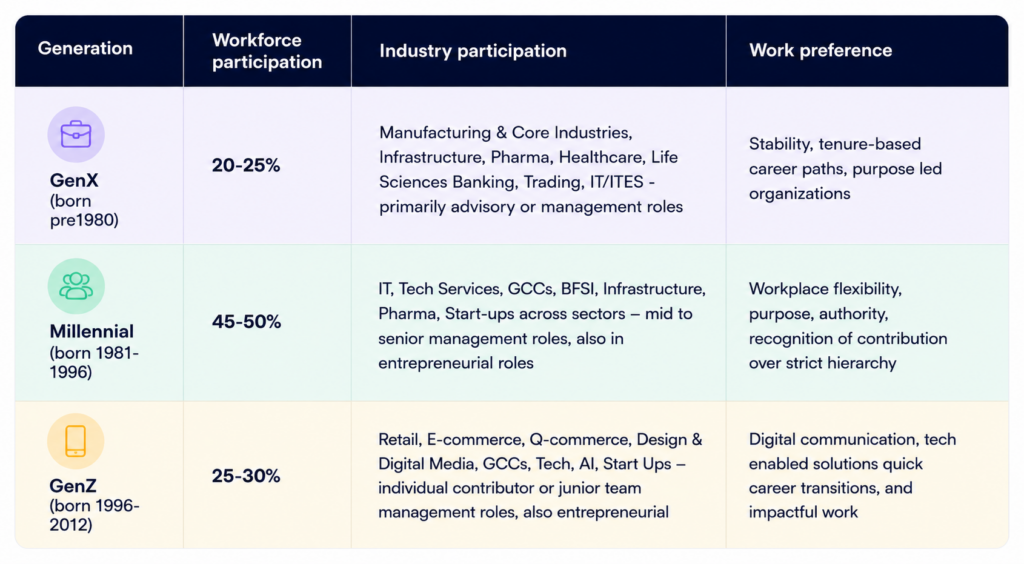
India is currently at a cusp of major generational transition in workforce. With an average workforce age of around 29 years, Industry 5.0 getting stronger, and technology changing workplace realities almost every day, organizational design and workforce strategies in India need fresh thought.
A Sneak peek into current workforce realities in India is as follows:
While India had a contract workforce in blue-collar jobs from the 1970s, temp or flexi staffing started growing in the IT/ ITES & BFSI spaces from the late 1990/ early 2000’s. India also had professionals, commonly called as freelancers, who used to provide services to organizations on their own. However, except for the Contract Labour (Regulation and Abolition) Act 1970, there was no law governing the services of such engagements. The Code of Social Security 2020 provided the guidelines of entitlements, gig and flexible employment, which changed the workplace paradigm to a great extent. Let’s examine this change a bit deeper.
The Indian Gig Landscape: Scale & Evolution
- Distinct Growth Drivers: Unlike Western economies shaped by post-industrial shifts, India’s gig explosion is propelled by an immense young talent pool, hyper-smartphone penetration, and a critical demand for livelihood opportunities.
- The Digital Catalyst: Hyper-growth platforms like Swiggy, Zomato, Uber, and Ola—alongside professional freelancing networks like Upwork and Fiverr—have scaled service delivery to unprecedented levels.
- The Historic Corporate Incentive: Organizations originally gravitated toward this model for aggressive cost-cutting. Using independent contractors eliminated traditional office overheads, equipment costs, and strict permanent-employee compliance.
- The K-Shaped Talent Divide: As highlighted by NITI Aayog, the market has split into two extremes: highly skilled, high-earning freelance consultants (tech, design, strategy) and a vulnerable mass of low-skilled platform workers (delivery and ride-hailing partners) facing high income insecurity.
- Current State: In 2026, the gig and contractual workforce forms approximately 16% of all jobs in India and over 2% of the total workforce, projected to grow by about 38% Y-O-Y. While permanent roles still make up about 72% of planned corporate hires, non-permanent work constitutes nearly a quarter of total national employment opportunities. The gig economy is bifurcated by skill and industry:
- High-Skilled Gig Workers: Expected to reach 27.5% of the gig economy by 2030. This group comprises software developers, digital marketers, graphic designers, and specialized consultants.
- Low-to-Medium Skilled Gig Workers: Projected to make up 33.8% of the gig pool by 2030, primarily driven by e-commerce, quick-commerce (Q-commerce), logistics, and ride-sharing apps.
The Labour Codes
India adopted the Labour Codes by subsuming 29 different laws into 4 Labour Codes. Most notably, the Code on Social Security 2020 officially defines “gig” and “platform” workers for the first time.
The core regulatory mandates include:
- Equal benefits for non-permanent staff, including gratuity for fixed-term staff.
- The Aggregator Tax: Digital platforms and intermediaries are now legally required to contribute 1% to 2% of their annual turnover to a dedicated State Social Security Fund (capped at 5% of total payouts to gig workers).
- Portable National Identities: Workers must register on the government’s e-Shram portal to receive a Universal Account Number (UAN). This ensures their welfare benefits remain portable across different platforms and states.
- Access Thresholds: To qualify for state-backed social security, a worker must be active with one aggregator for at least 90 days in a financial year, or 120 days across multiple platforms. Earning a single rupee counts as an active day.
- Institutional Grievance Support: Companies must now operationalize structured grievance redressal mechanisms, including call centers and physical facilitation booths, to support this historically invisible workforce.
Future Staffing Strategies
The demographic realities of India, the pace of change of technology and the current regulatory framework show the following pointers that need consideration:
- Value Over Cost-Arbitrage: We can no longer treat gig/ temp hiring as a race to the bottom to avoid social security costs. Hiring strategies must shift from simple cost-cutting to building strategic, value-added ecosystems with independent talent.
- Data-Driven Talent Supply Chains: The e-Shram portal and UAN tracking will bring transparency to the unorganized workforce. Businesses must leverage advanced data analytics to map talent availability, geographic spread, and specialized skills nationwide.
- The End of Rolling Contracts: Under the new Fixed-Term Employment (FTE) guidelines, temporary contract workers are entitled to equal wages, medical benefits, and leaves. Crucially, gratuity eligibility drops from 5 years to just 1 year. Rolling short-term contracts can no longer be used to bypass benefits.
- Gig Employer Branding: As gig workers gain legal rights, they will choose platforms with the best corporate reputations. Retaining top freelance talent now requires transparent payment terms, swift dispute resolution, and a fair ecosystem.
This surely creates a level playing field for those who want to choose flexi/gig opportunities, provides a legal backing to gig/flexi and allows organizations to rethink their staffing strategies.
Focus/changes in people processes:
For HR departments, these changes demand immediate operational and systematic adjustments.
- Rigorous Digital Compliance: HR policies must adapt to track extensive data. We must digitally audit and log engagement histories, earnings data, and platform hours to accurately report who meets the 90-day and 120-day social security thresholds.
- Mitigating Misclassification Risks: HR must work alongside legal counsel to carefully draft agreements. Mixing up the definitions of independent contractors, platform workers, and FTEs carries heavy compliance penalties.
- Payroll & System Updates: Payroll and corporate finance systems must be re-engineered to accurately deduct and remit the mandatory 1% to 2% turnover levy into the government’s central fund without operational delays.
To sum up
The era of viewing gig workers as disposable, low-cost labour is officially over. The future belongs to agile organizations that seamlessly integrate permanent employees, fixed-term contractors, and digital freelancers into a single, compliant, and highly valued workforce.
One Response
Awesome article Sanjeeb. In depth. Insightful. And very enlightening. Very rightly pointed out that the evolution of the Indian gig industry is fundamentally different from western and developed economies.
The boom of e-commerce and delivery based services has created a lot of opportunity for the younger generation in India. And the updated labour codes now recognise this substantial workforce formally.
You are absolutely right when you say that HR departments and organisations need to relook at how they integrate contract and freelance workers into a formal setting.
In my opinion the demographic dividend we have all spoken about for decades is playing out… just very differently from how it was anticipated. And it poses a very unique and interesting proposition for organisations and HR professionals of the future.